 AI
Proof
Pricing
Book a demo
Scan your code free
AI
Proof
Pricing
Book a demo
Scan your code free
AI
Proof
Pricing
Book a demo
Scan your code free
AI
Proof
Pricing
Book a demo
Scan your code free
Hard sources — not covered by free tools
Also parsed — certify what free tools miss
Runtimes
After migration
Talend .item files, tMap components, and job designs parsed structurally. Converted to PySpark notebooks on Databricks with Delta Lake. Full lineage, validated parity.
Deterministic parsers read the estate and emit native Databricks code — not Talend jobs re-pointed at a cloud warehouse.
Talend → MigryX parser → PySpark + Delta + Workflows
 TalendStudio jobs.item / projecttMapJoin + transformContextsEnv bindingsRoutinesJava helpersMigryX Parser
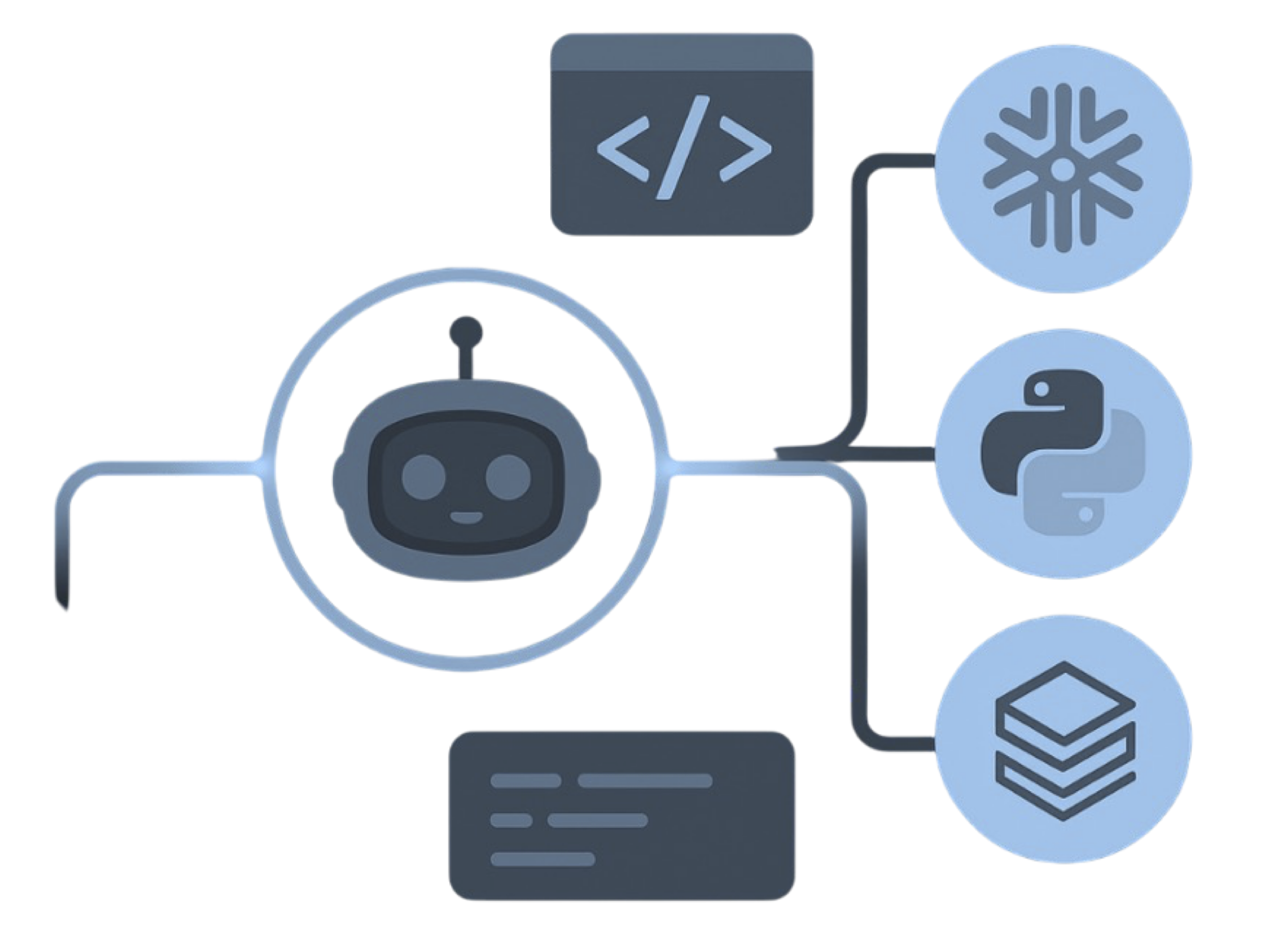 Deterministic parseAI where it helps
 Row-level parityBefore cutover
 PySpark emitSet-based, not loops
 Workflow emitJob DAGsDatabricksPySpark notebooksSet-based, not loopsDelta LakeACID + time travelWorkflowsReplaces schedulerUnity CatalogColumn lineageRepos + DABsCI/CD promote
 MLflowWhere models live
MigryX AI handles the logic parsers cannot resolve alone, and every change it makes goes through the same parity checks. It runs on a model you approve, air-gapped if your estate requires it.
Talend's tMap component embeds join conditions, filter expressions, and column transformations inside .item XML files. MigryX parses every tMap structurally and converts lookups, joins, and expressions to native PySpark DataFrame operations.
Custom and system routines in Talend are compiled Java code tightly coupled to the Studio runtime. Databricks runs Python natively. MigryX translates routine logic to Python modules and PySpark UDFs that run distributed across clusters.
Talend's tRunJob component chains jobs linearly with limited error handling and no conditional branching. Databricks Workflows provide DAG-based orchestration, parameterized runs, retry policies, and event-driven triggers natively.
A Talend tMap with lookup join, filter expression, and column mapping - converted to PySpark DataFrame joins and withColumn transformations. No Java code generation, no single-node bottleneck.
// Job: Customer_Revenue_Segmentation
// tOracleInput_1: CUSTOMER_TRANSACTIONS
//   SELECT cust_id, amount, txn_date
//   FROM transactions WHERE amount > 1000
//
// tMap_1:
//   Main: row1 (transactions)
//   Lookup: row2 (customer_master)
//   Join: row1.cust_id = row2.cust_id
//   Filter: row1.amount > 1000
//   Expression: segment =
//     row1.total_spend > 50000 ? "Platinum"
//     : row1.total_spend > 10000 ? "Gold"
//     : "Standard"
//   Output: cust_id, segment, amount
//
// tAggregateRow_1:
//   GroupBy: segment
//   Sum: amount → segment_revenue
//   Count → customer_count
//
// tOracleOutput_1: CUSTOMER_SEGMENTS
# tMap + tAggregateRow → PySpark on Databricks
from pyspark.sql import functions as F

transactions = spark.read.table("customer_transactions") \
    .filter(F.col("amount") > 1000)

customers = spark.read.table("customer_master")

segmented = (
    transactions.join(customers, "cust_id", "inner")
    .withColumn("segment",
        F.when(F.col("total_spend") > 50000, "Platinum")
         .when(F.col("total_spend") > 10000, "Gold")
         .otherwise("Standard"))
    .groupBy("segment")
    .agg(
        F.sum("amount").alias("segment_revenue"),
        F.count("*").alias("customer_count")
    )
)

segmented.write.format("delta").mode("overwrite") \
    .saveAsTable("customer_segments")
tMap lookup join and filter expressions become DataFrame .join() and .withColumn(). tAggregateRow becomes .groupBy().agg(). Output writes to Delta Lake with ACID guarantees.
| Talend Component | Databricks Equivalent | Notes |
|---|---|---|
| tMap | .join().withColumn() | Lookup joins, filters, and expressions preserved |
| tAggregateRow | .groupBy().agg() | All aggregate functions supported |
| tFilterRow | .filter() / .where() | All predicate expressions preserved |
| tSortRow | .orderBy() | Multi-column sort with ASC/DESC |
| tFileInputDelimited | spark.read.csv() | Schema, delimiters, header options mapped |
| tOracleInput / tMySQLInput | spark.read.jdbc() | JDBC connection properties preserved |
| Context variables | Widget parameters | Environment-specific configs externalized |
| Routine (Java) | Python module / UDF | Custom + system routines translated |
| tRunJob | Workflow task | Job chaining → DAG orchestration |
| Joblet | Shared notebook | Reusable sub-jobs become shared modules |
| tLogRow | display() / print() | Debug output preserved for validation |
| tOutput (DB/File) | Delta Lake .write.format("delta") | ACID writes with schema enforcement |
Data Matching compares Talend job output against Databricks output - row by row, column by column.
See how Data Matching works →28 regulated enterprises, including six global systemically important banks, have modernized with MigryX. Customer names are shared under NDA in a demo, with reference calls on request.
See all engagements →