
 NEW
Qlik to dbt migration
AI
Proof
Pricing
Book a demo
Get the free assessment
NEW
Qlik to dbt migration
AI
Proof
Pricing
Book a demo
Get the free assessment
NEW
Qlik to dbt migration
AI
Proof
Pricing
Book a demo
Get the free assessment
NEW
Qlik to dbt migration
AI
Proof
Pricing
Book a demo
Get the free assessment
Targets
Warehouses
Runtimes
Before migration
After migration
SAS, Alteryx, DataStage, and COBOL · Regulated enterprises
MigryX is enterprise software that converts SAS, COBOL, Alteryx, DataStage, and other legacy code into native Databricks, Snowflake, BigQuery, or Python. Parsers convert 95%+ of typical code, MigryX AI fixes the rest, and every row is validated against the original before cutover.
The assessment runs on your machine. Nothing is uploaded.

Runs on the model you approve: Azure OpenAIAmazon BedrockGoogle Vertex AIDatabricksSnowflake CortexSelf-hosted
Why migrations stall
Three reasons: the license renewal arrives before the plan is ready, the code is rewritten by hand, and nobody can prove the new output matches the old. MigryX is built to remove each one.
License renewals arrive before the migration plan is ready, so the platform you want to leave gets another multi-year contract.
Parsers convert most of the code, so the plan is ready before the renewal is.
Consultants rewrite thousands of programs by hand. It is slow, costly, and every rewrite is a new chance to change a number.
Deterministic parsers give the same output every run. MigryX AI handles what they can't.
Risk and audit teams won't sign off on "it looks right." Without evidence, cutover slips and both platforms keep running.
Every result is compared row by row, and the report is the evidence.
How it works
Every conversion runs the same four-step loop: parsers convert, Data Matching validates row by row, MigryX AI fixes what differs, and the result is checked again. Nothing is accepted until the outputs match the original.
First · DiscoverScan the legacy estate. Build the inventory, lineage, and complexity scores that scope the work: Compass.
Source-specific parsers rewrite the code deterministically.
Data Matching compares target output to the original, row by row.
MigryX AI reads the exception report and logs, and proposes a fix for the blocks that differ.
Validated again. Accepted when it matches, or routed to an engineer.
Then · Hand offAccepted code and its evidence go to your platform's own scheduler, such as Databricks Workflows or Airflow. After go-live, Atlas keeps the lineage current.
Sources: SAS, COBOL, Alteryx, Qlik, Oracle ODI, DataStage, DataFlux, Talend, and Informatica. Targets: Databricks, PySpark, Polars, Snowflake, AWS Glue, BigQuery, Microsoft Fabric, Iceberg, and dbt. Pick a source to see how it converts.
Source technologies
Don't see your stack? Tell us what you're running →
Notable enterprise customers
 SAS
SAS DataStage
 Alteryx
 Talend
 Oracle ODI
 Mainframe COBOL
 Databricks
 PySpark
 Snowflake
 dbt
dbt Google Cloud
 Python
 Informatica IDMC
Most migrations run on Spark.
6 of these are global systemically important banks. Those 6 are inside the 18.
The 18, 7, and 3 count enterprise customer organizations: 28 in total. One customer can run more than one migration, so this is not a migration count. 50+ small customers also run MigryX on a subscription, and they are not in these figures.
Want to hear it from a customer? Ask in your demo and we will arrange a reference call with a team that ran a similar migration.
Ask for a reference callAlongside platform migration tools
Use the platform tool where it fits. MigryX covers the rest and proves the result.
| Capability | Lakebridge (Databricks) | SnowConvert AI (Snowflake) | BigQuery Migration Service | MigryX adds |
|---|---|---|---|---|
| Target | Databricks | Snowflake | BigQuery | Databricks, Snowflake, BigQuery and others |
| SQL dialects → target | Yes, free | Yes, free | Yes, free | Yes |
| Informatica, Teradata, DataStage | Teradata, DataStage | Teradata; Informatica in preview | Teradata (SQL, BTEQ, TPT) | All three, deterministic parser |
| SAS | Assessment (Analyzer) | Outside its scope | Outside its scope | Conversion of Base, macros, IML |
| Data validation | Reconcile module | Data validation, some sources | Data Validation Tool | Row-level parity with exception report |
| Lineage | Unity Catalog | Snowflake | Dataplex | Atlas, across platforms, as of any date |
| Where it runs | Locally, with a Databricks workspace | Desktop app; AI features use Snowflake | Google Cloud service | Self-hosted, including fully disconnected |
Platform tool columns summarize each vendor's public documentation as of September 2026. MigryX also converts COBOL, copybooks and JCL batch; Alteryx, Qlik, ODI and DataFlux; and signs an evidence pack in Atlas.
Already converted with a platform tool? The certify pilot compares that output with the source, row by row.
Moving to Databricks? MigryX converts SAS and COBOL batch, with row-level proof.
Book a demo →Validation
Data Matching compares every row and every aggregate of the new output against the original, and the report it produces is the evidence auditors and risk teams sign off on.
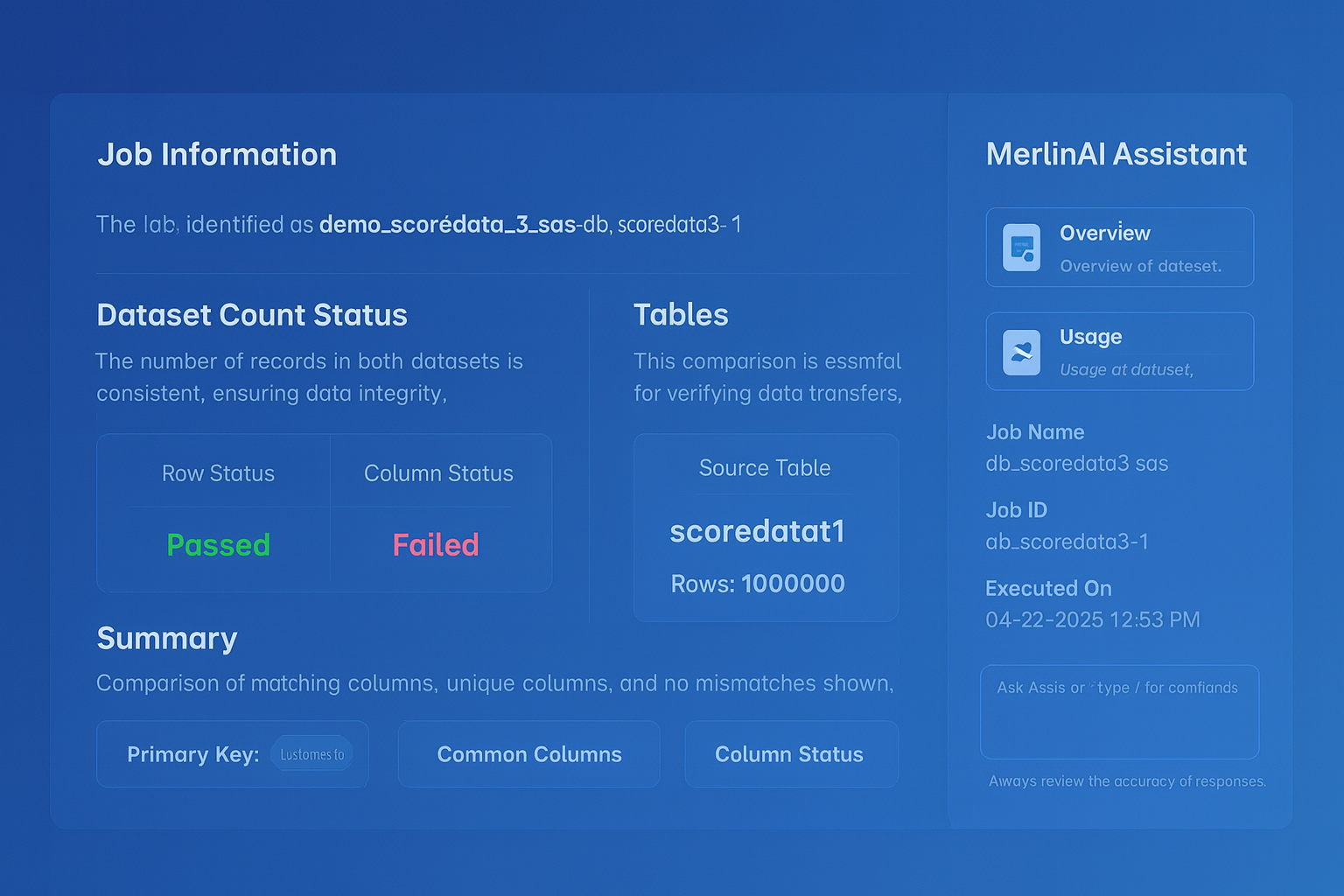 Data Matching report: row-level parity validation
Pricing
Per line of code, at rates published on our site. No per-consultant rates and no "contact us for a quote" to get a first number. The free assessment counts your code, and the pricing page turns that count into a cost.
Deployment
As a hosted SaaS portal at app.migryx.com with nothing to install (request access), or self-hosted in your own environment: Docker, Kubernetes, OpenShift, or a Windows VM. Self-hosted, your source code never leaves your network.
app.migryx.com, nothing to install, migrate from your browser. Request access →
One-command install on-premises or in your private cloud: Docker, Kubernetes, or OpenShift. With AI off or a self-hosted model, there are no outbound connections and it runs fully disconnected.
SSO (LDAP, Okta, SAML), role-based access, and full audit logs come standard.
FAQ
Deterministic parsers convert 95%+ of typical code out of the box, and MigryX AI proposes fixes for ambiguous macros and undocumented logic. Whatever the mix, nothing is accepted until row-level parity passes, and the validation report is the proof.
Not unless you choose to. Self-hosted MigryX runs on-premises or in your own cloud (Docker, Kubernetes, or OpenShift, air-gapped capable) and your code never leaves your environment. Prefer zero setup? The SaaS portal at app.migryx.com runs the same engine in our secure cloud.
Yes. The parsers and row-level validation run without MigryX AI, and many air-gapped estates run parser-only. When AI is on, it runs on a model you approve, and every change it makes is validated again before it is accepted.
Partitioned validation compares row-level and aggregate outputs between legacy and modern targets. Automatic schema checks, data matching reports, and exception trails provide audit-ready evidence.
A first look is a short readiness review. A pilot then runs on a slice of your estate and proves results against your baseline, usually within a few weeks. Scope for the full estate comes out of that work. Book a demo and we will put a range on your code.
Not with Convert: it is software your team runs, with no services contract or RFP. If your team knows the legacy platform but not the target, Guided adds six months of execution, remediation, and reconciliation support. With Full stack, our engineers manage delivery end to end and hand over documented, readable code.
Sources: SAS, Talend, Qlik, DataStage, Informatica, COBOL, SSIS, Oracle PL/SQL, ODI, Teradata BTEQ, Alteryx, DataFlux, and SQL. Targets: Databricks, Snowflake, BigQuery, Microsoft Fabric, AWS Glue, PySpark, Polars, Iceberg, dbt, and Python, plus SQLMesh and Informatica IDMC.
Automated migration uses a parser that reads the legacy language (SAS, COBOL, DataStage, Alteryx) and generates equivalent code for the target platform, the same way every run. A manual rewrite has consultants read each program and retype it, which is slow, costly, and introduces a new chance of error in every program. MigryX automates the conversion and the proof; people review exceptions instead of rewriting code.
The converted program and the original run on the same input, and Data Matching compares the two outputs row by row on key columns, then compares row counts, sums, nulls, and distinct values. Every difference is listed in an exception report with the row, the column, and the values. A program is accepted only when that report is empty, and the report is the evidence kept for auditors.
Parsers. A parser produces the same output every run, so results are repeatable and reviewable, which is what audit and model-risk teams require. An LLM can produce different code each time and cannot guarantee it preserved the logic. MigryX uses parsers for the 95%+ of code they handle, applies MigryX AI only to the blocks they cannot resolve, and validates every AI change row by row before it is accepted.
Please visit our pricing page. pricing page
Databricks Lakebridge, Snowflake SnowConvert AI, and BigQuery Migration Service are the platforms' own migration tools, focused on SQL dialects, and MigryX works alongside them. MigryX converts SAS, COBOL, Alteryx, DataStage, and other sources to any of those targets, validates the result row by row, and signs an evidence pack.
1. Run the free assessment to inventory the SAS estate and size it. 2. Convert with the SAS parsers to PySpark and Delta; MigryX AI handles the macros they cannot resolve. 3. Run both versions on the same data and validate row by row with Data Matching. 4. Fix exceptions and re-check until the report is clean. 5. Hand accepted jobs to Databricks Workflows and switch SAS off. The walkthrough is on migryx.com/sas/databricks. SAS2PY is a MigryX brand.
MigryX has offices in Indianapolis, USA and Hyderabad, India, and serves customers in North America, Europe, the UK, the Middle East, India, Southeast Asia, Australia, and Latin America. Software is delivered as self-hosted installs or through the SaaS portal, so location does not limit deployment. Growth-region pricing applies where the installation is licensed.
Book a 30-minute demo and we will walk a workload you already run. Questions? Contact us
Get Started
Leave your email and we send the free assessment. It runs on your machine, counts and sizes your code, and uploads nothing.
One field: your email. The download link arrives in your inbox. Run it on your code and get counts, complexity, and a size estimate in MCUs, our pricing unit (one MCU is about 500 lines of simple SAS).
Get the free assessment →Thirty minutes on a workload you already run. We show the converted output, what still needs a person, and how an engagement would run.
Book a demo →Run it with your team, with our support, or have us manage delivery. Your SI can lead it too. We scope that on the demo.
How we work →Trusted by 28 enterprise customers, including 6 global systemically important banks. See the proof, or ask for a reference call in your demo.
Notable enterprise customers
SASDataStageAlteryxTalendOracle ODIMainframe COBOLDatabricksPySparkSnowflakedbtGoogle CloudPythonInformatica IDMCMost migrations run on Spark.
6 of these are global systemically important banks. Those 6 are inside the 18.
The 18, 7, and 3 count enterprise customer organizations: 28 in total. One customer can run more than one migration, so this is not a migration count. 50+ small customers also run MigryX on a subscription, and they are not in these figures.
Want to hear it from a customer? Ask in your demo and we will arrange a reference call with a team that ran a similar migration.
Ask for a reference call